Sunday, 10 July 2016

PATTERNS & SEQUENCE


SEQUENCE

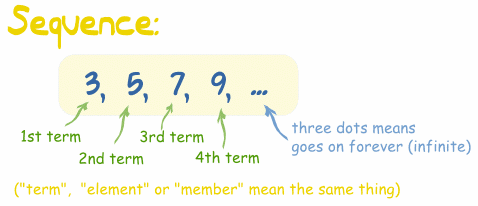
sequence, in mathematics, is a string of objects, like numbers, that follow a particular pattern. The individual elements in a sequence are called terms. Some of the simplest sequences can be found in multiplication tables:

  • 3, 6, 9, 12, 15, 18, 21, …
    Pattern: “add 3 to the previous number to get the next number”
  • 0, 12, 24, 36, 48, 60, 72, …
    Pattern: “add 12 to the previous number to get the next number”
Of course we can come up with much more complicated sequences:
  • 10,–2 8,×2 16,–2 14,×2 28,–2 26,×2 52, …
    Pattern: “alternatingly subtract 2 and multiply by 2 to get the next number”
  • 0,+2 2,+4 6,+6 12,+8 20,+10 30,+12 42, …
    Pattern: “add increasing even numbers to get the next number”
We can also create sequences based on geometric objects:
Triangle Numbers
Pattern: “add increasing integers to get the next number”
1
3
6
10
15
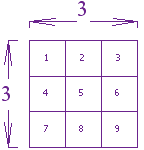
Square Numbers
Pattern: “add increasing odd numbers to get the next number”

Note that the sequences of triangle and square numbers also have numerical patterns like the ones we saw at the beginning. To find the following triangle numbers we have to add increasing integers to the last term of the sequence (+2, +3, +4, …). To find the following square numbers we have to add increasing odd numbers (+3, +5, +7, …).


EXAMPLES FOR PATTERNS AND SEQUENCE

Triangular Numbers

1, 3, 6, 10, 15, 21, 28, 36, 45, ...
Its is generated from a pattern of dots which form a triangle.
By adding another row of dots and counting all the dots we can find the next number of the sequence:
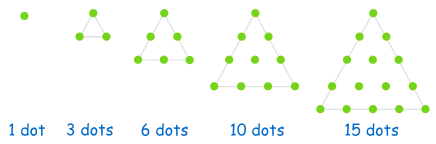
triangular numbers

Square Numbers

0, 1, 4, 9, 16, 25, 36, 49, 64, 81, ...
They are the squares of whole numbers:
0 (=0×0)
1 (=1×1)
4 (=2×2)
9 (=3×3)
16 (=4×4)
etc...


Example: What is 3 squared?


3 Squared== 3 × 3 = 9
"Squared" is often written as a little 2 like this:
square root of 9 is 3
This says "4 Squared equals 16"
(the little 2 says the number appears twice in multiplying)

Squares From 12 to 62

1 Squared=12=1 × 1=1
2 Squared=22=2 × 2=4
3 Squared=32=3 × 3=9
4 Squared=42=4 × 4=16
5 Squared=52=5 × 5=25
6 Squared=62=6 × 6=36

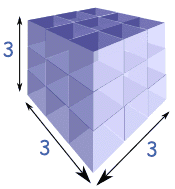
Cube Numbers

1, 8, 27, 64, 125, 216, 343, 512, 729, ...
They are the cubes of the counting numbers (they start at 1):
1 (=1×1×1)
8 (=2×2×2)
27 (=3×3×3)
64 (=4×4×4)
etc...

Cubes and Cube Roots

To understand cube roots, first we must understand cubes ...

How to Cube A Number

To cube a number, just use it in a multiplication 3 times ...

Example: What is 3 Cubed?


3 Cubed=cube 3x3x3=3 × 3 × 3=27
Note: we write down "3 Cubed" as 33
(the little 3 means the number appears three times in multiplying)

Some More Cubes

4 cubed=43=4 × 4 × 4=64
5 cubed=53=5 × 5 × 5=125
6 cubed=63=6 × 6 × 6=216

Cube Root

cube root goes the other direction:
3 cubed is 27, so the cube root of 27 is 3
3cube root direction27
The cube root of a number is ...
... a special value that when cubed gives the original number.
The cube root of 27 is ...
... 3, because when 3 is cubed you get 27.
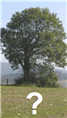
tree root 
Note: When you see "root" think
"I know the tree, but what is the root that produced it?"
In this case the tree is "27", and the cube root is "3".
Here are some more cubes and cube roots:
4
 
64
5
 
125
6
 
216

Example: What is the Cube root of 125?

Well, we just happen to know that 125 = 5 × 5 × 5 (if you use 5 three times in a multiplication you will get 125) ...
... so the answer is 5


References:

Saturday, 2 July 2016

GEOMETRIC PROGRESSIONS


Sequence is a set of things (usually numbers) that in order.

Sequence

In a Geometric Sequence each term is found by multiplying the previous term by a constant.

For geometric sequences, the common ratio is r, and the first term a1 is often referred to simply as"a".

 Since you get the next term by multiplying by the common ratio, the value of a2 is just ar

The third term is a3 = r(ar)ar2. 

The fourth term is a4 = r(ar2)ar3. 

Following this pattern, 


the n-th term an will have the form 


an = ar(n – 1).


Examples of Geometric Sequence


Example 1:


2, 4, 8, 16, 32, 64, 128, 256, ...

This sequence has a factor of 2 between each number. Each term (except the first term) is found by multiplying the previous term by 2.
In General we write a Geometric Sequence like this:
{a, ar, ar2, ar3, ... }
where:
  • a is the first term, and
  • r is the factor between the terms (called the "common ratio")

2, 4, 8, 16, 32, 64, 128, 256, ...

The sequence starts at 1 and doubles each time, so 


  • a=1 (the first term)
  • r=2 (the "common ratio" between terms is a doubling)

And we get :

{a, ar, ar2, ar3, ... }
= {1, 1×2, 1×22, 1×23, ... }
= {1, 2, 4, 8, ... }

But be careful, r should not be 0:
  • When r=0, we get the sequence {a,0,0,...} which is not geometric

The Rule

We can also calculate any term using the Rule:
xn = ar(n-1)
(We use "n-1" because ar0 is for the 1st term)
Example 2:
10, 30, 90, 270, 810, 2430, ...
This sequence has a factor of 3 between each number.
The values of a and r are:
  • a = 10 (the first term)
  • r = 3 (the "common ratio")
The Rule for any term is:
xn = 10 × 3(n-1)
So, the 4th term is:
x4 = 10×3(4-1)
= 10×33 
= 10×27 
= 270
And the 10th term is:
x10 = 10×3(10-1) 
= 10×39 
= 10×19683 
= 196830

Example 2:
A Geometric Sequence can also have smaller and smaller values:

Example:

4, 2, 1, 0.5, 0.25, ...
This sequence has a factor of 0.5 (a half) between each number.
Its Rule is 
xn = 4 × (0.5)n-1

Summing a Geometric Series

When we need to sum a Geometric Sequence, there is a handy formula.
To sum:
a + ar + ar2 + ... + ar(n-1)
Each term is ark, where k starts at 0 and goes up to n-1
Use this formula:
Sigma

a is the first term
r is the "common ratio" between terms
n is the number of terms
Sigma(called Sigma) means "sum up"
And below and above it are shown the starting and ending values:

Sigma Notation

It says "Sum up n where n goes from 1 to 4. 
Answer = 10

The formula is easy to use ... just "plug in" the values of ar and n

Example of Summing a Geometric Series


Sum the first 4 terms of

10, 30, 90, 270, 810, 2430, ...
This sequence has a factor of 3 between each number.

The values of a, r and n are:
  • a = 10 (the first term)
  • r = 3 (the "common ratio")
  • n = 4 (we want to sum the first 4 terms)
So:
Sigma
Becomes:
Sigma
You can check it yourself:
10 + 30 + 90 + 270 = 400
And, yes, it is easier to just add them in this example, as there are only 4 terms. But imagine adding 50 terms ... then the formula is much easier.

References:

Friday, 1 July 2016

ARITHMETIC PROGRESSION


ARITHMETIC SEQUENCE
Sequence is a set of things (usually numbers) that in order.
Sequence
 Arithmetic Sequence the difference between one term and the next is a constant.
in other words, we just add the same value each time ... infinitely.

If the first term of the sequence is a then the arithmetic progression is

a, a + d, a + 2d, a + 3d, . . . 


where the n-th term is

a + (n − 1)d. 


The sum of an arithmetic series Sometimes we want to add the terms of a sequence. 


Examples of Arithmetic Sequence

Example 1:
1, 4, 7, 10, 13, 16, 19, 22, 25, ...
This sequence has a difference of 3 between each number.
The pattern is continued by adding 3 to the last number each time, like this:
In General we could write an Arithmetic Sequence like this:
{a, a+d, a+2d, a+3d, ...}
Where:
  • a is the first term, and
  • d is the difference between the terms (called the "common difference")
1, 4, 7, 10, 13, 16, 19, 22, 25, ...
Has:
  • a = 1 (the first term)
  • d = 3 (the "common difference" between terms)
And we get:
{a, a+d, a+2d, a+3d, ... }
= {1, 1+3, 1+2×3, 1+3×3, ... }
= {1, 4, 7, 10, ... }


Example 2:
3, 8, 13, 18, 23, 28, 33, 38, ...
This sequence has a difference of 5 between each number.
The pattern is continued by adding 5 to the last number each time, like this:
We can write an Arithmetic Sequence as a rule:
xn = a + d(n-1)
(We use "n-1" because is not used in the 1st term).
Write the Rule, and calculate the 4th term for
3, 8, 13, 18, 23, 28, 33, 38, ...
This sequence has a difference of 5 between each number.
The values of a and d are:
  • a = 3 (the first term)
  • d = 5 (the "common difference")
The Rule can be calculated:
xn = a + d(n-1)
= 3 + 5(n-1)
= 3 + 5n - 5
= 5n - 2
So, the 4th term is:

x4 = 5×4 - 2 = 18

Examples of Arithmetic Progression


Find the sum of the first 50 terms of the sequence 

1, 3, 5, 7, 9, . . . . 

Solution This is an arithmetic progression, and we can write down 

a = 1 , d = 2 , n = 50

We now use the formula, 

so that 

Sn = 1/2 n(2a + (n − 1)d) 
S50 = 1/2 × 50 × (2 × 1 + (50 − 1) × 2) 
= 25 × (2 + 49 × 2) 
= 25 × (2 + 98) 
= 2500 .

Find the n-terms of first sequence 

1, 3, 5, 7, 9, . . . 

1, 
1 + 2,
 1 + 2 × 2,
 1 + 3 × 2,
 1 + 4 × 2,
 . . . , 

and 

this can be written as

 a, 
a + d,
 a + 2d,
 a + 3d,
 a + 4d,
 . . . 

where 

a = 1 is the first term,

 and 

d = 2 is the common difference.
 If we wanted to write down the n-th term, 
we would have 

a + (n − 1)d


References: